
← BE SAVER
Sellick Maneuver Trainer
Trains correct cricoid pressure application during airway management
- Product type
- Full simulator
- Clinical area
- Anesthesia & Emergency Care
View overview
Sellick Maneuver Trainer
Sellick Maneuver Trainer
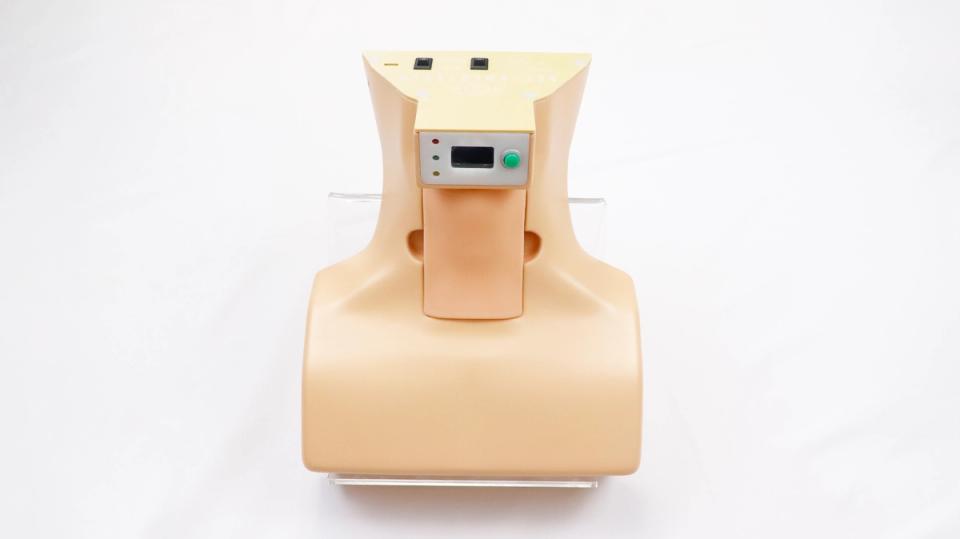
The Sellick maneuver trainer replicates the cricoid cartilage as an anatomical landmark, allowing students and early-career practitioners to learn or consolidate the Sellick maneuver used during lung ventilation and emergency and obstetric anesthesia; the realistic anatomical structure and instant electronic feedback significantly enhance the learning process. The trainer also helps build muscle memory with monitoring of the pressure applied.
Can be used for accreditation examinations.
Skills practiced:
- Practicing the Sellick maneuver (cricoid pressure, cricoid force): applying optimal pressure to the cricoid cartilage to prevent regurgitation during anesthesia;
- Training the application of external force to the cricoid cartilage, compressing the esophagus against the cervical vertebrae;
- Occluding the elastic esophagus while the airway lumen is preserved thanks to the rigidity of the cricoid cartilage;
- Protecting the airway from gastric contents during the interval between loss of consciousness and inflation of the endotracheal tube cuff (protection against aspiration during tracheal intubation);
- The Sellick maneuver is also used as a component of emergency intubation in training programs for emergency medical physicians in the Russian Federation;
- Applying light pressure (no more than 10 N) to the cricoid cartilage until loss of consciousness, then applying 30 N of pressure after loss of consciousness;
- Selecting the correct compression point. The assistant to the anesthesiologist performing intubation locates the cricoid cartilage (palpating the thyroid cartilage, the cricothyroid membrane in the depression below it, and the cricoid cartilage below that) and places the index finger at its center, with the thumb and middle finger positioned laterally;
- While the patient is conscious, a force of 10 newtons is applied — equivalent to the force exerted on a support by a resting 1-kilogram object. Once sedation sets in, the force is increased to 30 newtons (3 kg);
- Cricoid pressure is considered to improve visualization of the vocal cords during direct laryngoscopy; however, in some cases the pressure must be eased so that the anesthesiologist can see the vocal cords. Pressure may be reduced only while laryngoscopy continues, so that regurgitation is not missed;
- Judging the applied force: recognizing insufficient or excessive pressure on the cricoid cartilage;
- Understanding what forces of 10 and 30 newtons feel like is achieved through training;
- Modes: training/examination.
Package contents:
- Trainer body — 1 pc.
- Skin replica (transparent) — 1 pc.
- Skin replica (beige) — 1 pc.
- Larynx replica — 1 pc.
- User manual;
- Transport packaging.
Interested in this system?
Request a quote or a guided demo from our team.